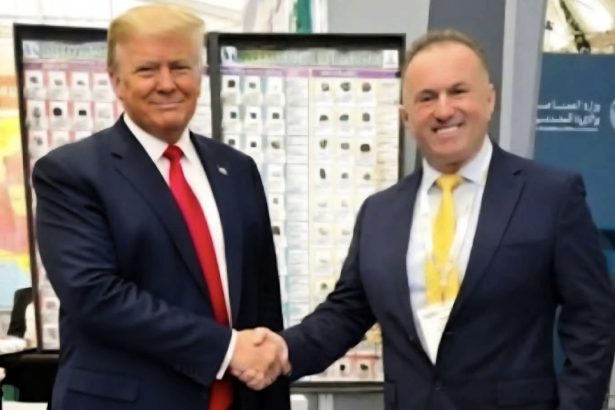

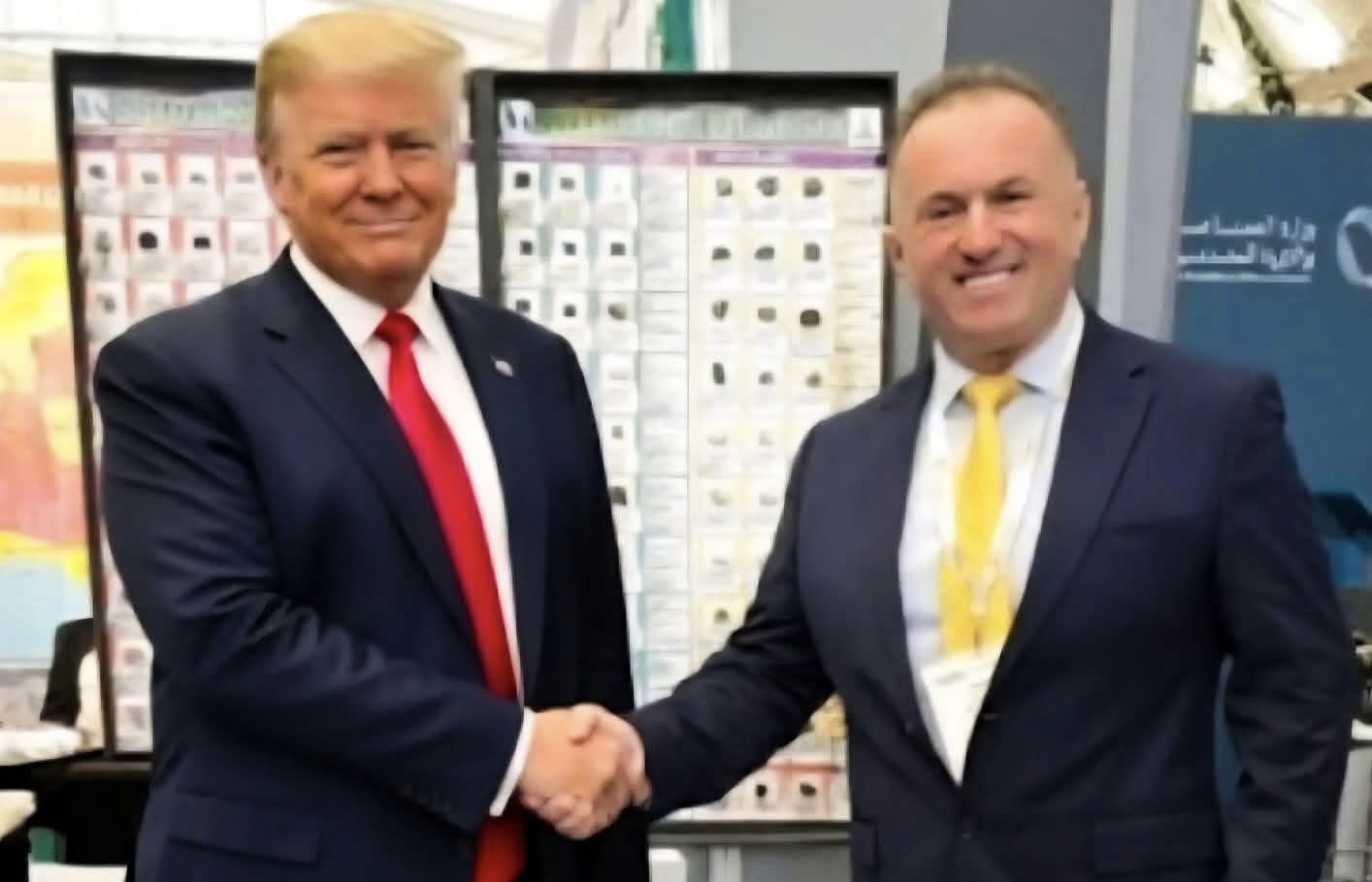
In an exclusive interview for Journal Magazine, Albanian-American businessman from Tropoja, philanthropist Sahit Muja — a close friend of current U.S. President Donald Trump — shares his strategic vision on the role of American gas in the new energy map of Europe and the Balkans.
From New York, where he has built a multi-decade career in mining and energy investments, Muja analyzes how American LNG can be transformed from a mere supply source into a development platform for Albania and Kosovo. His message is direct: energy is not simply a commodity, but the foundational capital of the industry of the future and the cornerstone of national security.

Mr. Muja gave this interview to Journal Magazine, which features American gas in the Balkans as the central theme of this issue. Below is the full interview with Mr. Muja for Journal Magazine.
American Gas as a Strategic Bridge: Sahit Muja’s Message for Albania and Kosovo
Sahit Muja sees energy as the foundation upon which modern civilization has been built. In his assessment, American natural gas — and especially LNG — has gained an irreplaceable role following the energy crisis that struck Europe after the interruption of Russian supplies. “Energy security is economic security, industrial security and, ultimately, national security,” he emphasizes.
Journal Magazine: Mr. Muja, you are one of the most prominent Albanian-American businessmen in the natural resources sector. How do you see the role of American gas today in the global economy and in U.S. energy security?
Mr. Muja: I see energy as the foundation upon which modern civilization has been built. In the case of the United States, the development of the energy industry has been one of the main engines that built the world’s most powerful economy, industry, and technology.
American natural gas plays an extraordinarily important role and, in my view, will continue to do so in the decades ahead. The reason is simple: a modern economy cannot function without abundant, reliable, and competitive energy.
It is enough to look at the energy crisis Europe experienced after the disruptions and uncertainties of Russian gas supplies. Energy prices rose sharply, production costs increased, inflation spread through the economy, and many European industries lost competitiveness.
This teaches us a strategic lesson: energy security is economic security, industrial security and, ultimately, national security.
Today the United States is not merely a major gas producer. It has become one of the main pillars of the new global energy architecture. American LNG gives Europe and its allies the opportunity to diversify supply and reduce dependence on single sources.
Journal Magazine: Albania has taken concrete steps toward accepting a 20-year agreement for American LNG. How positively do you view this decision by Tirana, and what strategic benefits does it bring to Albania?
Mr. Muja: I see it as a decision of major strategic importance. Since the establishment of democracy, Albania has had a special strategic relationship with the United States and, at important moments in its modern history, has shown that it knows how to listen carefully to its allies.
A long-term supply of American LNG can give Albania a new dimension of energy security. Gas can serve as a flexible source that complements hydropower and other resources, especially during periods when hydroelectric production is lower.
But I see something even greater.
Albania should not view gas merely as an imported commodity. It should view energy as strategic infrastructure for the transformation of the country.
Albanian tourism is growing, industry needs energy, data centers require reliable supply, investors seek security, and a modern economy demands predictable energy infrastructure.
Albania’s geographic position makes this even more important. The country can be transformed from a relatively small energy market into a strategic energy hub for the Western Balkans.
And I firmly believe in one principle: strategic partnerships work in both directions. Our allies stood by us in the most difficult moments; it is in our national interest to build economic and energy partnerships that strengthen our shared future.
Journal Magazine: Do you see this development — Albania accepting American gas and the project toward Kosovo — as a concrete opportunity for deeper energy integration between Albania, Kosovo, and the rest of the Balkans?
Mr. Muja: Absolutely. In fact, I believe we should see this as much more than a gas project.
It is an opportunity to build a new Albanian-American energy corridor for the Balkans.
Albania and Kosovo have a natural economic, geographic, and human connection. If this connection is accompanied by modern energy infrastructure, it can create a new development platform for the entire region.
An integrated system can link LNG, gas, hydropower, solar energy, wind energy, electricity grids, energy storage, and in the future also hydrogen.
This would create something far greater than a pipeline: a regional energy ecosystem.
Albania can become the entry gateway, Kosovo can serve as a market and emerging industrial center, while connections with North Macedonia, Montenegro, and further with Europe would expand this architecture.
In the 21st century, energy infrastructure is a form of geopolitical infrastructure. Whoever builds the networks, ports, pipelines, and transmission lines of the future also builds the foundations of economic development for the decades to come.
Journal Magazine: What would be the main benefits for Kosovo if it signed long-term contracts for American gas — in terms of energy security, the environment, and the economy?
Mr. Muja: When I arrive in Pristina during the winter and land at “Adem Jashari” International Airport, I often immediately feel a major problem: the air heavy with pollution.
Kosovo faces serious air pollution challenges, while energy production heavily based on lignite and outdated technology creates large environmental and health costs.
At the same time, the country faces the need for more energy and supply interruptions that harm families and businesses.
I also have a personal connection to this reality. I have a house in Gjakova and have personally experienced the uncertainty of energy supply — outages that can last for hours and are especially difficult for a modern economy.
How can a competitive industry be built, how can thousands of jobs be created, and how can major investments be attracted if energy is not secure and affordable?
Gas is not the only solution and should not be the final goal. But it can be a strategic bridge: providing more stable energy and flexibility for the system while Kosovo builds much greater capacity in renewables, storage, and clean technologies.
Secure energy brings investment. Investment brings industry. Industry brings jobs. Jobs bring prosperity.
Therefore, for Kosovo, energy is not merely a technical issue. It is a matter of national development.
Journal Magazine: American LNG exports have changed Europe’s energy map since 2022. How do you see the future role of the United States in the energy security of Europe and the Balkans?
Mr. Muja: I have been investing for more than 30 years in American energy companies and, as an investor, I have had the opportunity to closely follow the transformation of this sector.
What I see today is an America that is strengthening production, infrastructure, technologies, and international energy partnerships.
The United States has a unique combination: large natural resources, extraordinary capital, developed financial markets, leading universities and technology, experienced energy companies, and a wide network of international alliances.
Partnerships with major producing countries, including Qatar, also show that future energy security will be built through cooperation and diversification, not through dependence on a single source.
For Europe and especially for the Balkans, the American role will remain very important.
I would summarize it this way:
America should not be merely the supplier of Europe’s energy; America can be Europe’s partner in building the energy architecture of the 21st century.
Journal Magazine: What should Albania and Kosovo do to turn energy security into a new development platform?
Mr. Muja: They must think beyond individual projects. We need to build a vision in which gas, electricity, hydropower plants, solar, wind, storage, hydrogen, and new energy technologies function as parts of a single system.
Albania and Kosovo have extraordinary potential to build a new energy corridor in the Western Balkans. But this requires long-term vision, capital, infrastructure, and above all political will.
I would like to see a 20–30-year strategy in which both countries sit down with American and European partners and draft a joint plan for energy, industry, and investment.
Because energy should not be thought of only as consumption. Energy is the starting capital of the industry of the future.
Journal Magazine: How do you see the role of the United States in supporting Kosovo’s energy transition? Should American gas be part of this transition?
Mr. Muja: Yes. I believe the United States can play a very large role in Kosovo’s energy transformation.
But we must understand the concept of transition correctly. Transition does not mean shutting down an old system and waiting for a new system to appear immediately.
You must build the bridge to the future.
American gas can be part of this bridge, providing flexibility and security while Kosovo develops more solar, wind, storage, and other clean technologies.
With abundant and reliable energy, Kosovo can become much more attractive to American and international companies looking to invest in industry, technology, data centers, and manufacturing.
Unfortunately, I believe Kosovo should have done much more to present these opportunities in Washington and to attract American capital and companies. There is no time for delays.
Every year lost in building energy infrastructure is a year lost for investment, industry, employment, and well-being. Kosovo must act with urgency, but also with vision.
Journal Magazine: As an investor with deep knowledge of American energy markets, what message would you send to decision-makers in Pristina regarding the possibility of importing American gas?
Mr. Muja: My message is very direct: Do not look at America as a country from which you must always ask for something. Look at it as the partner with whom you can build something.
Kosovo is a small market compared to the size of the American economy. The United States does not need Kosovo to survive economically. But history has shown us something far more important: when the people of Kosovo were at their most difficult moment, America did not remain indifferent.
The United States became one of the strongest supporters of Kosovo’s freedom and security. This is part of history that must not be forgotten.
Today we have another opportunity: to turn that historical partnership into an economic and energy partnership of the 21st century.
Therefore my call to decision-makers in Pristina is clear: seriously study the possibility of American gas, build the necessary infrastructure, bring in American companies, create concrete projects, and present them in Washington.
Do not wait for investment to come by itself.
Go where the capital, technology, and vision are.
And my message to Kosovo’s politics is even stronger: political differences can be discussed, but the strategic interests of the state must stand above the interests of the day.
Kosovo needs energy. It needs industry. It needs jobs. It needs investment. It needs cleaner air and a more competitive economy.
And if a strategic partner such as the United States is ready to help build this future, Kosovo must have the wisdom and courage to seize this opportunity.
I would close with one sentence:
Kosovo must not wait for the future. Kosovo must build it — with secure energy, with American capital, with modern technology, and with a vision that goes beyond a single political mandate.
Sahit Muja
New York